

Anti-Corruption
Anti-Corruption
The company is committed to conducting business with honesty and fairness, emphasizing good corporate governance principles. The company has demonstrated its intent and commitment to opposing corruption and misconduct in all forms, as well as encouraging directors and employees at all levels to be conscious of anti-corruption and misconduct, fostering correct values and increasing stakeholders' confidence. This ultimately leads to maximum value creation and transparency for all stakeholders.
Strategic Aims and Performance
Strategic aims
The Company's Corporate Governance Report (CGR) 2025 was rated 5-star "excellent" for the fourth consecutive year, achieving an exceptional score of 109
The Company successfully communicated its anti-corruption policies and guidelines to 100% of directors, executives, and employees
Performance
The Company's Corporate Governance Report (CGR) 2025 was rated 5-star "excellent" for the fourth consecutive year, achieving an exceptional score of 109
The Company successfully communicated its anti-corruption policies and guidelines to 100% of directors, executives, and employees
Strategic aims
The Company's Corporate Governance Report (CGR) 2025 was rated 5-star "excellent" for the fourth consecutive year, achieving an exceptional score of 109
The Company successfully communicated its anti-corruption policies and guidelines to 100% of directors, executives, and employees
Performance
The Company's Corporate Governance Report (CGR) 2025 was rated 5-star "excellent" for the fourth consecutive year, achieving an exceptional score of 109
The Company successfully communicated its anti-corruption policies and guidelines to 100% of directors, executives, and employees
Operational and Management Framework
- Corporate Governance and Anti-Corruption
The Company is committed to conducting its business in accordance with the principles of good corporate governance. It is dedicated to conducting its business with honesty, integrity, fairness, social responsibility, and good governance, while building confidence among all groups of stakeholders by fostering awareness among employees at all levels to perform their duties with honesty and integrity. Accordingly, the Company has established an Anti-Corruption Policy, which stipulates that directors and personnel at all levels of the Company shall not accept any form of corruption, whether directly or indirectly, including the giving or receiving of money, gifts, presents, or any other improper benefits, as well as inappropriate entertainment, from persons involved in the business, including customers, debtors, creditors, suppliers, business partners, strategic partners, and other stakeholders. The Company also promotes awareness among personnel at all levels of the harmful effects of corruption and encourages the adoption of proper values, the performance of duties with honesty and integrity, refraining from seeking personal benefits from their positions or improperly providing benefits to others, as well as ensuring that personnel are aware of the penalties and the impacts and damages that may result from corruption - Business Code of Conduct and Compliance Monitoring
The Company has established a Code of Conduct to serve as a guideline for business operations and to promote good corporate governance practices. In addition, channels are provided for stakeholders to report cases of rights violations or observed misconduct that may be inconsistent with the Company’s Code of Conduct. The Company also maintains procedures for monitoring compliance with the Code of Conduct through complaint and whistleblowing channels available to both employees and external parties. Reports received through these channels are compiled and presented to the Corporate Governance for Sustainability Committee (CGS) on a quarterly basis.
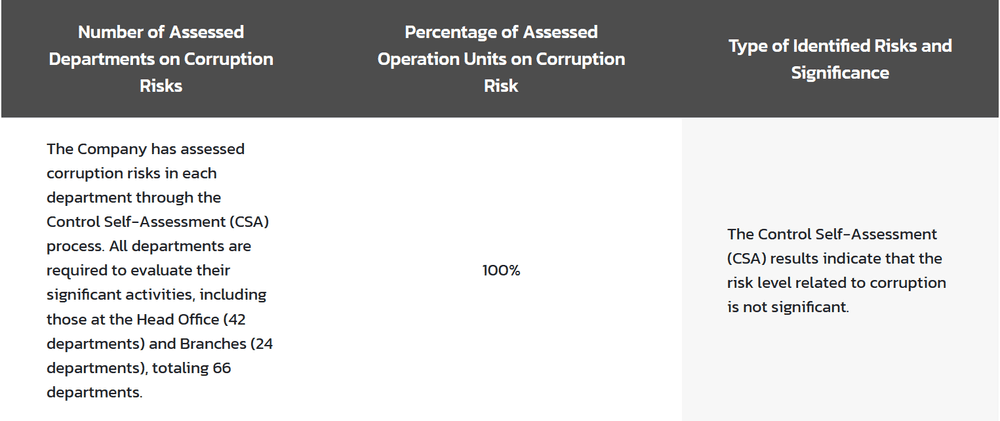
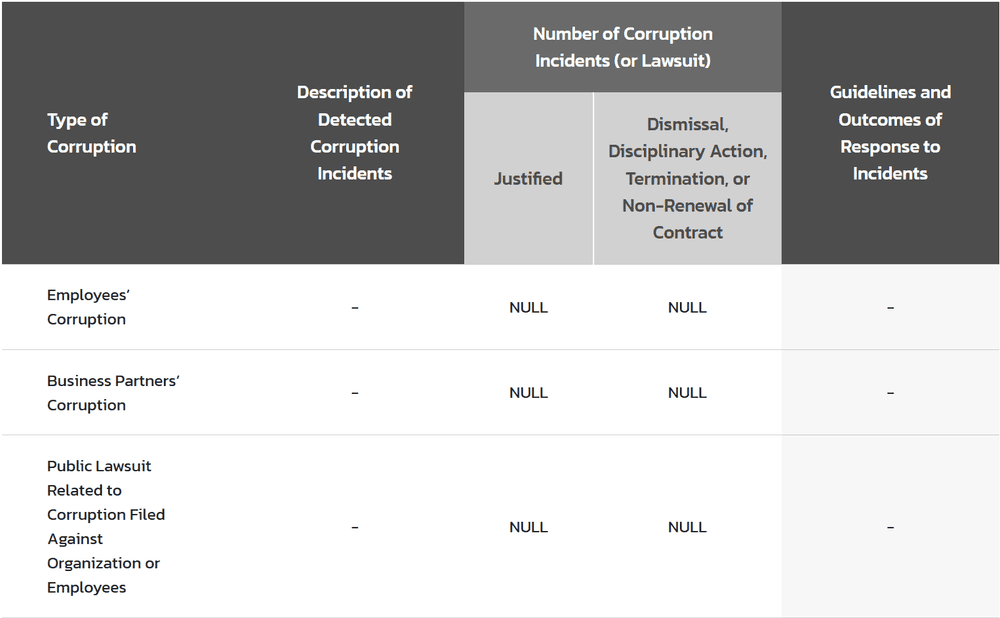
To ensure clarity and consistency in governance practices, the Company has documented its business conduct requirements in the Code of Conduct Handbook. No violations of the Company’s Code of Conduct were identified. The Company has established preventive and corrective measures to avoid recurrence and conducts fraud risk assessments across all departments throughout the organization to strengthen awareness of internal controls and fraud prevention. In the event that fraudulent or unethical conduct is detected within any business unit, employees are required to promptly report the matter to their supervisors or through the designated whistleblowing channels and to strictly comply with the Company’s Corporate Governance Code (CG Code) and Code of Conduct. - Disclosure and Conflict of Interest Management
Furthermore, the Company requires executives and employees to submit annual disclosure reports in accordance with its good corporate governance principles. These reports enable personnel at all levels to disclose and report information related to governance practices, including:
• Personal transactions that may potentially give rise to conflicts of interest with the Company, regardless of whether such conflicts have occurred during the reporting period;
• Actions or decisions taken within the scope of their responsibilities that may result in benefits to themselves or related parties; and
• Observations of fraudulent, unethical, or improper conduct, including violations related to the Company’s operations. - Review of Charters, Policies and Governance Manuals
The Board of Directors reviewed key governance policies, including the Policy on the Prevention of Insider Trading and Trading in Derivatives Contracts Based on Inside Information, as well as the Corporate Governance Code (CG Code), to ensure their continued effectiveness and relevance.
The Company also reviews its governance charters, policies, and manuals annually to ensure alignment with its corporate governance principles. All such documents were determined to remain appropriate and relevant to current circumstances. In addition, all executives and employees were required to submit annual governance disclosure reports. All executives and employees completed the disclosure process, representing 100% participation. The disclosure topics included Conflict of Interest reporting, Anti-Corruption reporting, and disclosures related to respect for human rights and fair labor practices. The summarized results of these disclosures were presented to the Corporate Governance for Sustainability Committee (CGS) for acknowledgment, review, and consideration of any further actions deemed necessary. - Anti-Money Laundering and Regulatory Compliance
In addition, the Company has implemented policies and operational guidelines on Anti-Money Laundering (AML), Counter-Terrorism Financing (CTF), and Counter-Proliferation Financing (CPF), together with customer identification, customer due diligence, and transaction reporting procedures in compliance with applicable anti-money laundering laws and related ministerial regulations. The Company recognizes the importance of complying with these laws to prevent its business operations from being used as a vehicle or intermediary for money laundering, terrorist financing, or the proliferation of weapons of mass destruction. These policies and procedures serve as standards and guidance for executives and employees in carrying out their duties. - Enhancing Board Effectiveness
The Board of Directors has designated the Chairman of the Audit Committee, or another independent director designated by the Board, to jointly consider the agenda for each Board meeting in order to promote an appropriate balance of power between the Board of Directors and Management, in accordance with the Corporate Governance Code for Listed Companies.
Currently, the Chairman of the Audit Committee is Mr. Vasant Thienhom. - Prevention of the Use of Inside Information
The Company has established the Policy on Prevention of the Use of Inside Information for Securities Trading or Entering into Derivatives Contracts to ensure that directors, executives, and employees acknowledge and comply with applicable laws and the guidelines prescribed by the Company. Key practices include prohibiting the use or disclosure of inside information, maintaining the confidentiality of information, establishing an abstain period, requiring advance notification of securities trading at least three business days prior to the intended trading date, requiring a minimum three-month holding period for securities, and reporting changes in securities holdings, as well as requiring confidentiality agreements or contracts for external parties who have access to inside information.
The Company publishes and communicates the policy and its practices through the Company’s website to enable external parties and stakeholders to access and acknowledge relevant information. The Company also communicates and promotes knowledge and understanding of the policy and its practices among directors, executives, and employees through email, the intranet, and infographics, as well as conducting knowledge and understanding assessments and continuously monitoring compliance with the policy. External parties who are authorized to access inside information are required to comply with the Company’s confidentiality requirements. In 2025, the Company did not identify any cases of violations relating to the use of inside information.
Code of Conduct → Anti-Corruption Policy →
Anti-Money Laundering, Counter-Terrorism Financing and Counter-Proliferation Financing Policy →
Table of Participants Trained in the Code of Conduct Course “Anti-Corruption Guidelines”
The Company has communicated and reinforced knowledge and understanding of key policies and guidelines, including the Prevention of Insider Trading and Derivatives Policy, Anti-Corruption Policy, Conflicts of Interest Policy, and Code of Conduct, to directors, executives, and employees for their acknowledgment and compliance. Furthermore, post-learning assessments have been conducted to evaluate participants' understanding and ensure effective knowledge retention.
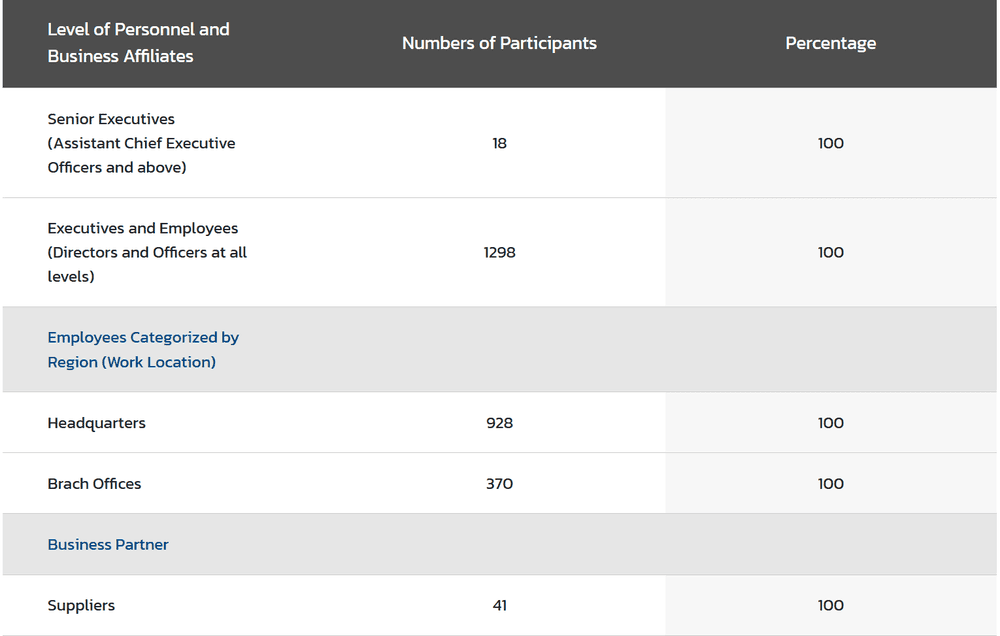
Table of Employees Informed About the Organization's Anti-Corruption Policies and Guidelines
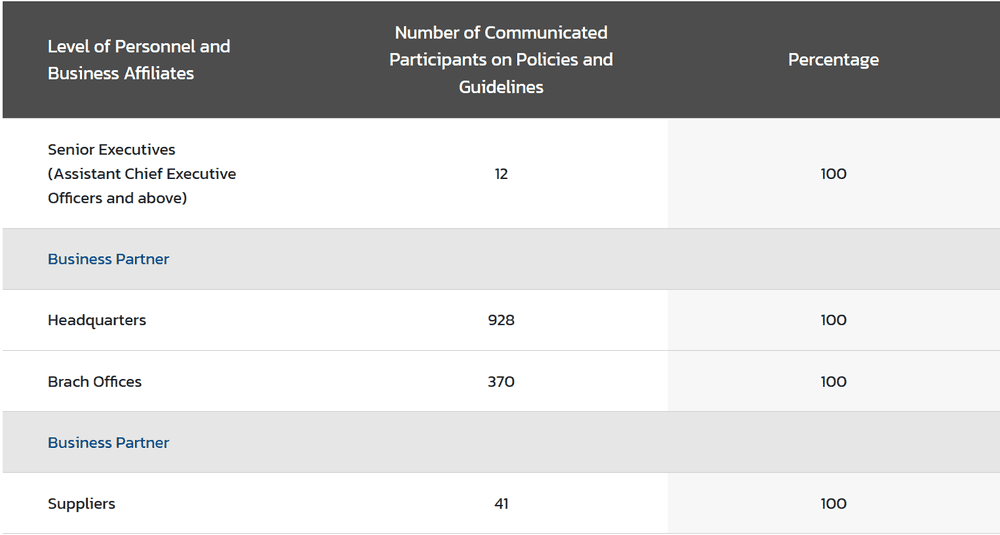
Following the communication of anti-corruption infographics to employees, personnel across the organization have demonstrated increased awareness and a proactive approach to improving their practices. This includes seeking clarification on key areas such as the giving or receiving of gifts and rewards and guidelines for engaging with government agencies. Employees have actively sought guidance from relevant departments via email and telephone to ensure compliance with proper procedures. Additionally, there is a growing initiative to enhance and refine the communication of anti-corruption policies through more engaging and visually clear infographics, improving overall understanding and adherence.
BAM is among the leading private organizations actively fostering transparency across the supply chain by empowering SME partners through capacity building and participation in CAC for SMEs. This strong support system not only strengthens corporate governance standards but also reinforces a sustainable business operation
Table of Assessed Departments on Corruption Risks
Justified and Commenced Corruption Incidents
Future Operation Strategies
.png&w=3840&q=75)
The Company has outlined a strategic plan to further enhance corporate governance (CG) and strengthen anti-corruption practices. By fostering a culture of integrity and transparency, the Company aims to sustainably uphold ethical business operations and reinforce its credibility as a listed company. Key initiatives include ensuring long-term operational excellence, building investor and stakeholder confidence, and conducting comprehensive training for employees at all levels. These training programs will raise awareness and ensure compliance with the principles of good corporate governance (CG Code), reinforcing a commitment to ethical business conduct across the organization.