To enhance employees' knowledge and skills, BAM encourages employees to pursue higher education in fields relevant to its business operations. Under this policy, the Company provides 20 scholarships per year for domestic master's degree programs and 2 scholarships per year for overseas master's degree programs for employees. In addition, the Company offers 10 scholarships for domestic master's degree programs and 2 scholarships for overseas master's degree programs to external candidates, with the objective of attracting high-potential, high-capability talent. These initiatives aim to strengthen the Company's talent pipeline and cultivate qualified professionals who can join the organization and play a vital role in supporting its long-term growth and development.


Employee Development
Employee Development
Employees are vital human capital who play a crucial role in creating economic value for both the organization and society. They also serve as a key driving force enabling the company to achieve its business objectives and goals. Accordingly, BAM consistently recognizes the importance of strengthening and developing its human resource management processes to ensure long-term effectiveness and sustainability. All employees nationwide are treated in accordance with principles of fairness, equality, and non-discrimination, under consistent standards applied throughout the entire employment lifecycle, from recruitment and employment, to employee development, talent retention, and termination of employment. This includes, for example, the provision of appropriate compensation and benefits in compliance with legal requirements, the establishment of equitable career growth and advancement pathways, and the implementation of systematic training and development plans to enhance employees’ skills and knowledge. These efforts aim to strengthen employee capabilities in alignment with the Company’s business growth direction. In addition, the Company encourages collaboration among employees and fosters a culture of giving by organizing various activities that contribute positively to society. (3-3)
The Company recognizes and places strong emphasis on developing the knowledge, skills, and capabilities of all employees, as competent personnel play a critical role in creating long-term organizational value. This includes improving operational efficiency, enhancing employee engagement and organizational commitment, maintaining an appropriate workforce balance, reducing employee turnover, and minimizing organizational costs arising from operational errors. Furthermore, the Company manages employee working hours in compliance with labor laws and implements systematic workforce planning, which is reviewed annually to ensure adequate staffing levels, reduce excessive workloads, and prevent working hours from exceeding legal limits. These efforts aim to cultivate employees with leadership potential and work flexibility, enabling them to adapt to future changes, while also encouraging innovation, creating business opportunities, and building long-term organizational sustainability.
Strategic Aims and Performance
Strategic Aims
Provide an average of at least
40 training hours per employee per year.
Performance
Provide an average of at least
41 training hours per employee per year.
Strategic Aims
Provide an average of at least
40 training hours per employee per year.
Performance
Provide an average of at least
41 training hours per employee per year.
Management Approach
BAM places strong emphasis on preparing and enhancing employees' skills and capabilities to ensure their ability to adapt to the Company's business direction and strategic objectives amid continuously changing conditions, including emerging technologies, evolving consumer behavior, and increasing business competition. Accordingly, the Company prioritizes sustainable training and employee development programs, with a commitment that 100% of employees receive training and development opportunities. The employee development plan is structured around the following key areas:
1. Strengthening organizational culture and core values among employees.
2. Career development to support professional growth and advancement.
3. Competency development to address performance gaps identified through performance evaluations.
4. Upskilling, reskilling, and new skill development to support business growth
The Company recognizes employee development as a critical strategy and a key objective in driving the organization towards the successful achievement of its vision and mission. Accordingly, the Company has established clear guidelines to ensure that employees are well-equipped and able to adapt to the Company's business direction and strategic objectives amid ongoing changes, including technological advancement, evolving consumer behavior, and intensifying business competition. These initiatives aim to enhance employees' knowledge, strengthen their skills, and promote adaptability, enabling them to respond to change in a timely and effective manner. The implementation is guided by two key operational policies:
In 2025, BAM continued to develop executives and employees to enhance their knowledge and skills for maximum effectiveness at the individual, departmental, and organizational levels through in-house training programs, public training courses organized by external institutions, and e-learning programs, totaling 174 training programs. These programs were categorized into key areas, including organizational culture development, sustainability enhancement, good corporate governance, risk management, human rights, digital skills, and career development. The average training cost per person was THB 22,625 per year, while the average training hours completed amounted to 41 hours per person per year.
Learning and Growth Perspective
BAM allocated a training budget of THB 30 million to enhance the skills, knowledge, and capabilities of a total of 1,326 employees, representing 100% employee participation in reskilling, upskilling, and new skill development programs under the 2025 annual plan within the Learning and Growth Perspective. These initiatives focus on improving operational efficiency, with the objective of ensuring that every employee has the opportunity to develop their potential, in line with the principle of One Person One Training (at least one training course per employee). Training is delivered through various formats, as follows: (404-2)
1. Self-learning programs provided online through the BAM E-Learning platform, comprising both internally developed courses tailored to the Company's business operations and programs conducted in collaboration with external institutions, such as SCB Academy and the Stock Exchange of Thailand.
2. Training through presentations, interactive discussions, and small group workshops.
3. On-the-Job Training
4. Public training programs organized by external institutions in both the public and private sectors.
Human Resource Development Monitoring and Evaluation Approach
To ensure that BAM's training and development programs are effective, up to date, and aligned with employees' needs and functional requirements, the Company has established a systematic process for evaluating training effectiveness. This process assesses learning outcomes at different levels and utilizes appropriate assessment and testing tools.
Evaluation Level
Reaction
Learning
Behavior
Outcomes หรือ Results
Assessment Tools
Pre-Test, Post-Test
Surveys, Informal Interviews
Roleplay
Behavioral Observation During Training, Participation Analysis
Performance Follow-up
Recognizing the importance of career development and progression for employees, the Company has defined structured learning and development pathways, categorized into three key programs as follows:
1. Leadership Succession Plan (LSP): This program is designed to enhance the knowledge and competencies of high-potential executives in alignment with the Company's managerial competency framework. The program includes learning from leaders of leading national organizations, developing capabilities in modern work practices through the use of AI tools, data-driven decision-making, Agile-based project management, and leadership development. These initiatives aim to prepare high-potential executives for future leadership roles.
2. Leadership Academy: This program focuses on developing managers and assistant managers across the organization. Participants receive training in leadership roles and responsibilities, task delegation and follow-up, team management, analysis of team members' strengths, appropriate task assignment, and conflict management. The program enhances managerial capabilities, enabling participants to effectively address challenges and respond to organizational needs.
3. Talent Development Plan (TA): This program is designed to develop high-potential employees to ensure readiness for advancement to higher-level positions. It supports the Company's business expansion and long-term growth, while also contributing to talent attraction and retention, thereby helping to reduce employee turnover.
Through the implementation of a systematic approach to monitoring the outcomes of employee potential development and career advancement initiatives, the Company has achieved various benefits, as outlined below:
1. Benefits to Employees
1.1 Acquisition of relevant skills required to effectively perform assigned roles and responsibilities.
1.2 Enhanced opportunities for career progression and advancement within defined career paths.
1.3 Development of competencies necessary to prepare for higher-level roles and responsibilities.
2. Benefits to the Organization
2.1 Improved organizational performance in both quantitative and qualitative aspects compared to previous levels.
2.2 Positive economic outcomes, including cost reduction, decreased losses or waste from operational processes, reduced workplace accidents, and more efficient resource utilization.
2.3 Enhanced employee morale and engagement through continuous training and development programs.
2.4 Reduction in conflicts, anonymous complaints, or grievances arising from management or operational practices of trained personnel.
2.5 Increased satisfaction among customers, service recipients, and relevant coordinating agencies.
Average Training Hours per Employee per Year

Performance Evaluation
BAM conducts employee performance evaluations twice a year, in June and December, to support decisions related to merit-based recognition, compensation adjustments, and workforce planning and development for the following year. The performance evaluation process comprises two key components:
1. Performance evaluation based on Key Performance Indicators (KPIs)
2. Competency assessment
Performance Evaluation Table

Lessons Learned in Employee Development
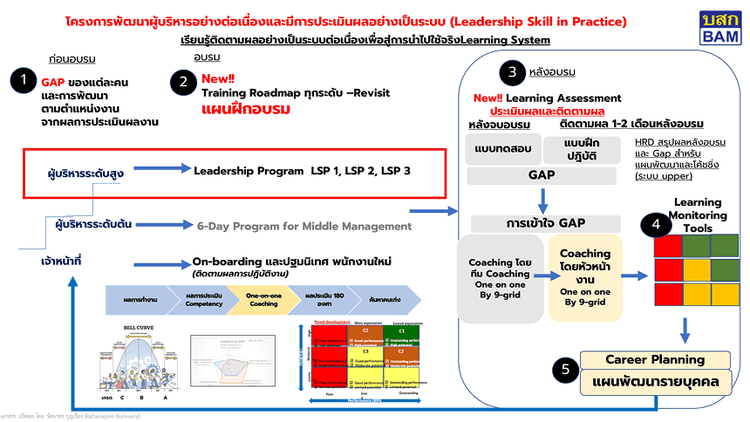
To promote continuous and sustainable human resource development, the Company analyzes evaluation results to determine appropriate employee development strategies. These initiatives are implemented through the “Leadership Skills in Practice” program, an ongoing executive development initiative supported by a structured monitoring and evaluation framework.