
Sustainable Supply Chain Management

Sustainable Supply Chain Management

BAM is committed to continuously developing and improving its supply chain management processes to address potential social and environmental impacts arising from both its operations and those of its suppliers. To this end, the Company has established criteria for the evaluation, selection, and due diligence of new suppliers, as well as procurement practices designed to promote good governance, including anti-corruption and sustainability considerations. In addition, the Company communicates its Supplier Code of Conduct and related policies to suppliers to demonstrate the Company’s expectations of suppliers in environmental, social, and governance (ESG) aspects. These measures aim to encourage suppliers to conduct business responsibly in alignment with the Company's Supplier Code of Conduct. The Company also conducts appropriate on-site assessments and monitoring of supplier operations.
Additionally, the Company recognizes and prioritizes the management of economic, social, and environmental risks, as well as reputational risks, appropriate to its business context. The Company also promotes the procurement of environmentally friendly products, supports sustainability education activities for suppliers, and maintains strict adherence to contractual payment timelines. These efforts aim to collectively build a stable, efficient, and sustainable supply chain that creates value for the environment and society.
 

Operational Objectives and Performance

Operational Objectives

Ensure that 460 suppliers formally acknowledge and sign the Supplier Code of Conduct, as well as related policies and guidelines for supplier engagement, including the Anti-Corruption Policy, Human Rights Policy and Guidelines, and established grievance and whistleblowing channels. 

Ensure 460 suppliers to complete a Self-Assessment covering Environmental, Social, and Governance (ESG) aspects.  

Conduct on-site operational audits and visits for 5 suppliers to monitor compliance and implementation practices 

Performance

Achieved 527 supplier acknowledgements and signatures on the Supplier Code of Conduct, along with related policies and guidelines for supplier engagement, comprising the Anti-Corruption Policy, Human Rights Policy and Guidelines, and established grievance and whistleblowing channels.

Completed self-assessments with 531 suppliers covering Environmental, Social, and Governance (ESG) aspects.  

Conducted on-site operational visits and inspections of 15 suppliers. 

Management Approach

Establishment of the Supplier Code of Conduct

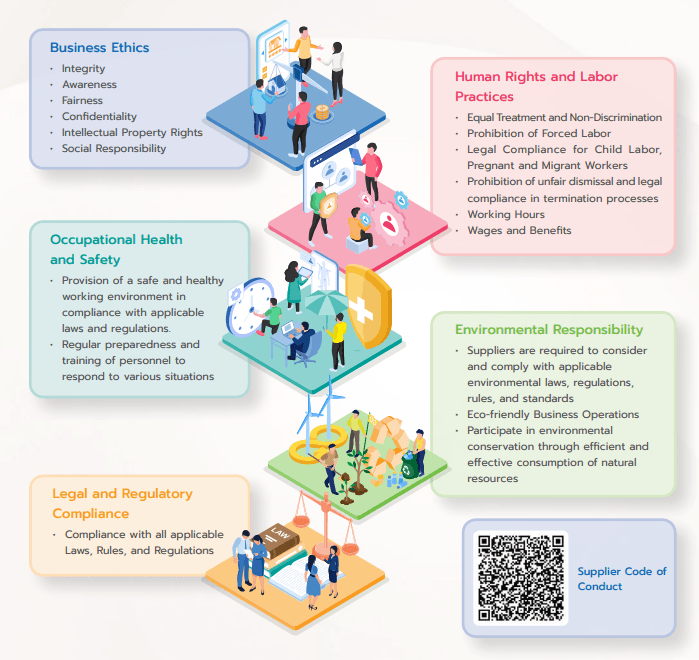
BAM has established a Supplier Code of Conduct, together with relevant supplier-related policies and guidelines, with the objective of promoting responsible and sustainable business practices among its suppliers. These instruments encourage suppliers to conduct their operations with due consideration for Environmental, Social, and Governance (ESG) aspects and serve as a practical framework to guide ethical business conduct. The Supplier Code of Conduct sets out expectations for suppliers to operate in accordance with ethical principles, respect human rights and fundamental freedoms, and ensure fair treatment of labor in line with human rights principles. It also emphasizes the importance of occupational health and safety in the workplace. The Supplier Code of Conduct encompasses five core areas of practice, as follows: 

1.    Business Ethics  
       •    Integrity 
       •    Awareness 
       •    Fairness
       •    Confidentiality
       •    Intellectual Property Rights
       •    Social Responsibility  
2.    Human Rights and Labor Practices
       •    Equal Treatment and Non-Discrimination
       •    Prohibition of Forced Labor 
       •    Legal Compliance for Child Labor, Pregnant and Migrant Workers
       •    Prohibition of unfair dismissal and legal compliance in termination processes 
       •    Working Hours 
       •    Wages and Benefits
3.    Occupational Health and Safety 
       •    Provision of a safe and healthy working environment in compliance with applicable laws and regulations.
       •    Regular preparedness and training of personnel to respond to various situations.  
4.    Environmental Responsibility
       •    Suppliers are required to consider and comply with applicable environmental laws, regulations, rules, and standards 
       •    Eco-friendly Business Operations
       •    Participate in environmental conservation through efficient and effective consumption of natural resources. 
5.    Legal and Regulatory Compliance 
       •    Compliance with all applicable Laws, Rules, and Regulations   
 

จริยธรรมทางธุรกิจ.png

Establishment of Procurement Practices to Promote Good Governance and Sustainability

BAM has established procurement guidelines centered on transparency, fairness, and verifiability. This includes promoting procurement with efficient suppliers while integrating Environmental, Social, and Governance (ESG) considerations. Furthermore, the Company is committed to empowering and supporting suppliers to enhance their capabilities for long-term sustainable growth alongside the organization. The guiding principles for supplier engagement are as follows:
     •    Implement a systematic, fair, and transparent supplier selection process while encouraging suppliers to conduct business ethically with social and environmental responsibility.  
     •    Commit to treating all suppliers with equality and fairness.
     •    Provide accurate information based on honesty, integrity, and fairness. 
     •    Prohibit the solicitation or acceptance of any improper commercial benefits from suppliers, and strictly adhere to contracts, agreements, and established conditions. In the event that contractual obligations cannot be met, the Company will collaborate with suppliers to identify resolutions based on reasonable and equitable principles.  
     •    Promote and support environmentally friendly products, as well as the development of technologies for energy efficiency and the pollution reduction.
 

Assessment and Selection of Existing and New Suppliers

BAM has integrated ESG criteria into the assessment and selection process for both existing and new suppliers, as well as into the criteria for the Approved Vendor List (AVL). This practice, implemented since 2020, covers environmentally friendly business practices, respect for human rights, fair labor practices, and business transparency (categorized by procurement type). This has resulted in the selection of new suppliers that align with sustainability principles, including green procurement, social responsibility, and good corporate governance.

Supplier Criteria and Categorization

BAM has established criteria and a supplier categorization framework to enable systematic analysis and formulation of procurement strategies. Suppliers are classified as follows:  
 

  • Critical Tier 1 Suppliers refer to vendors, contractors, and/or service providers that are of critical importance to BAM and whose performance may significantly impact the Company's business operations. 
        Assessment Criteria
         •    High total value of goods, services, or contract amounts 
         •    Goods or services that are non-substitutable or have limited supplier availability 
         •    High level of BAM's dependency on the supplier's goods or services 
         In 2025, the Company identified a total of 24 Critical Tier 1 suppliers, representing 4.7% of the total supplier base.    
  • Critical Non-Tier1 Suppliers refer to suppliers of BAM's Critical Tier 1 suppliers that deliver goods or services to those Tier 1 suppliers, whose absence may significantly impact the Company's business operations
        Assessment Criteria
         •    High total value of goods, services, or contract amounts 
         •    Goods or services that are non-substitutable or have limited supplier availability 
         •    High level of BAM's Critical Tier 1 suppliers' dependency on such goods or services 
        Based on impact assessments conducted in collaboration with the Company's Critical Tier 1 suppliers regarding potential effects from Critical Non-Tier 1 suppliers on the Company's operations, no suppliers were identified as Critical Non-Tier 1 suppliers in 2025.
     

2025 Performance

  • Suppliers directly engaging with the Company total 475 of Suppliers Share of Procurement Value 100%
  • Critical Tier 1 Suppliers total 24 of Suppliers Share of Procurement Value 4.7%
  • Critical Non-Tier 1 total 6 of Suppliers

Supplier Performance Evaluation

In 2025, BAM conducted performance evaluations of suppliers following the delivery of goods and services, particularly in cases of contract renewal. The evaluation criteria covered quality of goods or services, pricing, completeness and timeliness of delivery, and service/after-sales support. 

The scoring criteria and evaluation results for 2025 are as follows:  

  • Total suppliers evaluated: 350
  • Grade A (greater than 91%): 115 suppliers
  • Grade B (76%–90%): 181 suppliers
  • Grade C (50%–75%): 12 suppliers
  • Grade D (less than 50%): 2 suppliers

Supplier Risk Assessment

BAM recognizes the importance of encouraging suppliers to conduct business with good governance and responsibility toward the environment and society. Accordingly, the Company has established a risk management process aligned with criteria for identifying and assessing supplier risks across Economic, Social, Environmental, and Governance (ESG) dimensions. This process ensures that suppliers comply with legal requirements, ethical standards, and the Company's sustainability standards while supporting continuous supplier enhancement and development. Risk assessment is conducted through identification, analysis, and prioritization based on the evaluation of likelihood and potential impact.

The Company identifies supplier risks by considering risk factors based on Supplier Self-Assessment data, covering six key risk areas:
     1.    Business Ethics
     2.    Human Rights and Labor Practices
     3.    Occupational Health and Safety
     4.    Environmental Responsibility
     5.    Legal and Regulatory Compliance
     6.    Economic factors arising from BAM's suppliers

The Company categorizes Critical Tier 1 and Critical Non-Tier 1 suppliers by business type to establish clear priorities and manage service dependencies. This systematic approach helps mitigate risks associated with over-reliance on a limited number of suppliers or the receipt of services that do not meet specified requirements. The Company conducted risk assessments across 9 business categories, with a total of 22 Critical Tier 1 suppliers assessed, representing 100% of all Critical Tier 1 suppliers. The assessment results indicated that the majority of suppliers were rated at a low or “insignificant” risk level. In cases where risk levels are identified as “high” or “very high,” a mitigation plan with clearly defined timelines must be developed and implemented to reduce the identified risk level. 

ตารางแสดงผลการวัดระดับความเสี่ยง (Risk Matrix).png
  • Critical Tier 1 suppliers directly conducting business with the Company and assessed for sustainability risks (ESG Risk) across Human Rights, Environmental, Social, and Economic dimensions: 22 suppliers
    High-risk suppliers: 0 suppliers

Risk Factors and Risk Management

  • Business Ethics
    Risk level: Low
    Risk management: Compliance with the Supplier Code of Conduct
  • Human Rights and Labor Practices
    Risk level: Low
    Risk management: Compliance with the Supplier Code of Conduct
  • Occupational Health and Safety
    Risk level: Low
    Risk management: Compliance with the Supplier Code of Conduct
  • Environmental Responsibility
    Risk level: Low
    Risk management: Compliance with the Supplier Code of Conduct
  • Legal and Regulatory Compliance
    Risk level: Low
    Risk management: Compliance with the Supplier Code of Conduct
  • Economic factors arising from BAM’s suppliers
    Risk level: Low
    Risk management: Ongoing financial monitoring of Critical Tier 1 suppliers

Ongoing Supplier Engagement and Relationship-Building Activities

BAM is committed to fostering strong relationships with its suppliers through a range of continuous engagement activities. These activities are designed to proactively communicate the Company's business operations, policies, and operational guidelines, ensuring that suppliers fully understand the Company's expectations. Suppliers are required to conduct self-assessments using the Company's Self-Assessment form in accordance with the Supplier Code of Conduct, which comprehensively covers Environmental, Social, and Governance (ESG) aspects. In addition, the Company conducts supplier site visits and operational assessments, complemented by knowledge-sharing sessions, to build mutual understanding and strengthen long-term partnerships. Furthermore, the Company collaborates with suppliers to provide training programs for outsourced personnel, including service excellence, basic fire safety, and safe driving courses, among others.           

ภาพตรวจเยี่ยมคู่ค้า (1).png
ภาพการอบรม และป้องกันอัคคีภัย (1).png


Future Management Approach

future-direction_hero-banner_2.4-1_desktop(7).png
  • Increase the number of suppliers acknowledging and signing the Supplier Code of Conduct, ensuring full commitment to the Company’s policies and ethical guidelines.
  • Increase the frequency of site visits and operational inspections to enhance relationship management, while conducting annual training programs on the Supplier Code of Conduct and anti-corruption practices to ensure continuous compliance.
Sustainable Supply Chain Management